Dual-core RISC-V, Wi-Fi 6, Bluetooth 5.4, Thread and a gigabit Ethernet MAC on one chip
ESP32-S31: The New Maker Flagship
The ESP32-S3 has been the go-to “do everything” ESP32 for years. In 2026 Espressif finally gave it a successor: the ESP32-S31. It was unveiled in March, and by late July it had entered mass production and was available to buy. For makers it’s the most capable Wi-Fi microcontroller Espressif has shipped.
What's new
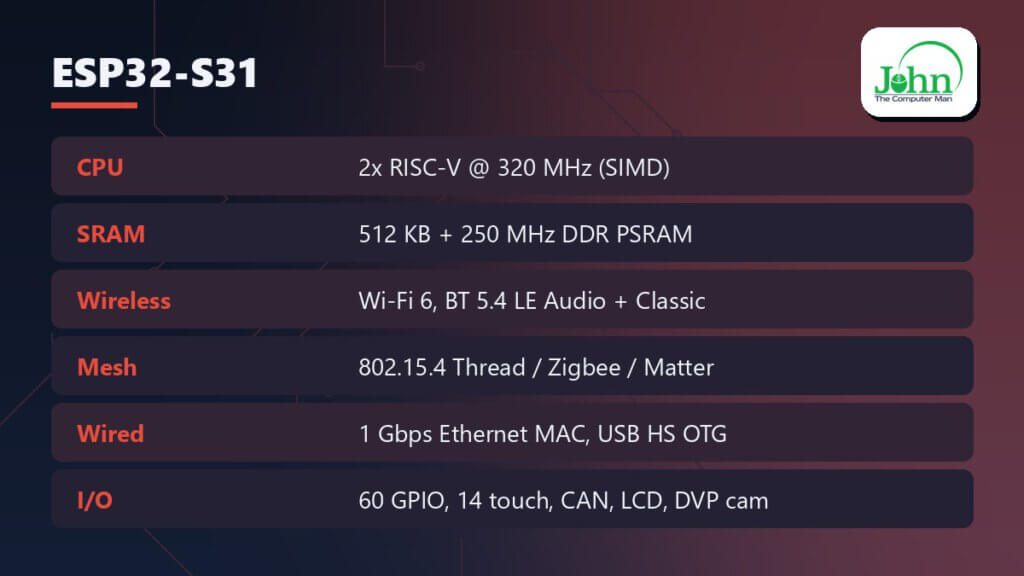
- Dual-core RISC-V at 320 MHz. Espressif has moved from Xtensa to RISC-V. One core has a 128-bit data path with SIMD instructions, which helps with audio, DSP and small ML models.
- Every radio you’d want. You get Wi-Fi 6 (2.4 GHz), Bluetooth 5.4 with LE Audio and Classic BR/EDR, and an 802.15.4 radio for Thread and Zigbee. That means Matter over Wi-Fi or Thread from one chip.
- Gigabit Ethernet MAC and high-speed USB OTG. Wired networking stops being a bolt-on.
- Made for screens. It has 8–24-bit parallel LCD with hardware color-space conversion, a DVP camera interface, a JPEG codec and a 2D graphics accelerator (PPA).
- Much faster memory. There’s 512 KB of SRAM plus 250 MHz DDR PSRAM, which can be read at the same time as flash.
- Better security. It adds PUF-based key storage, secure boot, flash/PSRAM encryption and a Trusted Execution Environment.
Why makers should care
The S31 fills a gap that used to need two chips. Before, a Bluetooth speaker with Wi-Fi control, a Matter bridge with a touchscreen, or a wired-plus-wireless sensor gateway each meant pairing parts. Now one chip handles each of them. Classic Bluetooth is back, so A2DP audio projects that people dropped after the original ESP32 are possible again. Espressif has also released a Linux BSP developer preview for the S31, so it’s worth keeping an eye on.
Project ideas
- Wi-Fi + Bluetooth audio streamer with a touch display for now-playing info.
- Matter/Thread border router that has an Ethernet uplink.
- Smart-home wall panel: an RGB LCD, capacitive touch buttons and Zigbee sensors, all on one chip.
- CAN bus logger for cars or e-bikes that uploads over Wi-Fi 6.
Getting started
Support is arriving first in ESP-IDF, and dev boards for IoT, smart-audio and HMI uses were shown in May. Arduino-ESP32 core support usually follows the IDF by a few releases. If you want Arduino today, check the latest core release notes before you buy a board. For now, the S3 is still the safe choice for production. The S31 is the chip to prototype your next project on.
Bottom line: if you’ve been waiting for “an ESP32-S3 with modern radios,” this is it.
