
5 GHz Wi-Fi on an ESP32, and a budget Wi-Fi 6 chip, now with stable ESP-IDF v6.0 support
Two ESP32 chips reached maturity in 2026. The ESP32-C5 and ESP32-C61 both got stable support in ESP-IDF v6.0 in March.
ESP32-C5: 5 GHz finally arrives
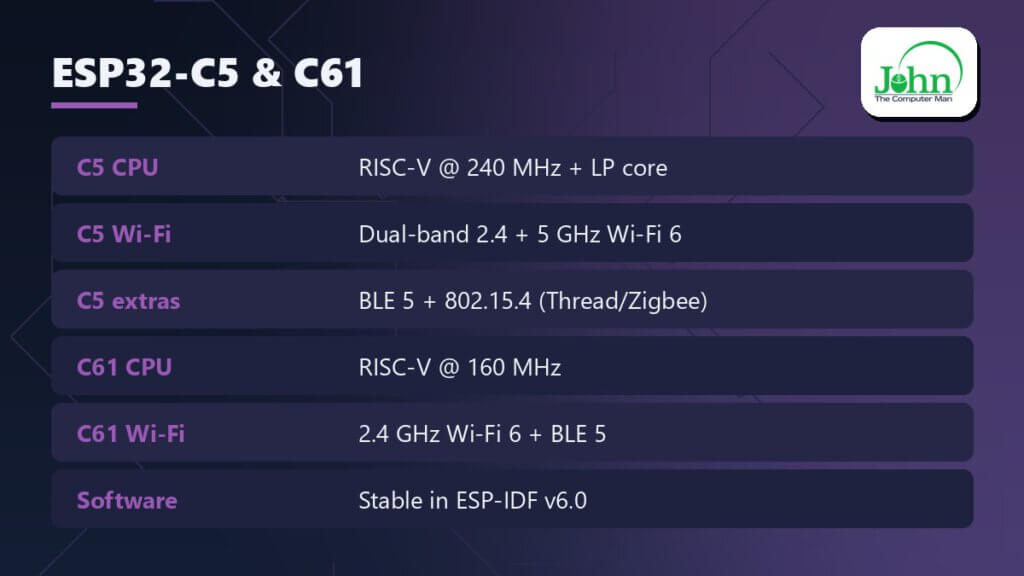
The C5 is Espressif’s first RISC-V chip with dual-band Wi-Fi 6 (2.4 GHz + 5 GHz). It also has Bluetooth LE 5 and an 802.15.4 radio for Thread and Zigbee. It runs at 240 MHz with a low-power co-processor and has been in mass production since April 2025.
Why 5 GHz matters:
- 2.4 GHz is crowded, especially in flats and offices.
- Some networks, like campuses, offices and mesh systems with band steering, are 5 GHz-only or prefer it.
- There’s less interference from microwaves, Bluetooth and baby monitors.
ESP32-C61: Wi-Fi 6 on a budget
The C61 is a cost-down C6. It has one RISC-V core at 160 MHz, 2.4 GHz Wi-Fi 6 and BLE 5, but no Thread or Zigbee. It has been in mass production since mid-2025. Pick it for sensor nodes where you want Wi-Fi 6 features like Target Wake Time (better battery life) and don’t need a mesh radio.
Which one should you buy?
| You need… | Pick |
|---|---|
| 5 GHz Wi-Fi | ESP32-C5 |
| Wi-Fi + Thread/Zigbee on one chip | C5 or C6 |
| Cheapest Wi-Fi 6 node | ESP32-C61 |
| Display, camera, lots of RAM | ESP32-S3 / S31 / P4 |
Handy ESP-IDF v6.0 extras
ESP-IDF v6.0 also added safe bootloader OTA updates on the C5 and C61, thanks to ROM-level bootloader recovery. That makes field updates much less risky. Espressif also noted fixes for PSRAM and sleep coexistence on the C5.
Arduino users
Recent Arduino-ESP32 3.x cores include C5 support, and the boards to look for include DFRobot’s FireBeetle 2 ESP32-C5, which also has solar charging. Standard WiFi.h code works as normal. Your sketch just gains access to 5 GHz networks.
Bottom line
If your Wi-Fi projects keep dropping off a busy network, the C5 is the easiest fix you’ll find this year.
