
STCC4, SGP41, SEN66 and BME690 make it easier than ever to build a proper indoor air monitor
Indoor air quality is one of the most useful things you can measure at home. High CO2 makes you sleepy, VOCs come from paint and cleaning products, and fine particles come from cooking. 2026 brought several sensors that make a good monitor small and affordable.
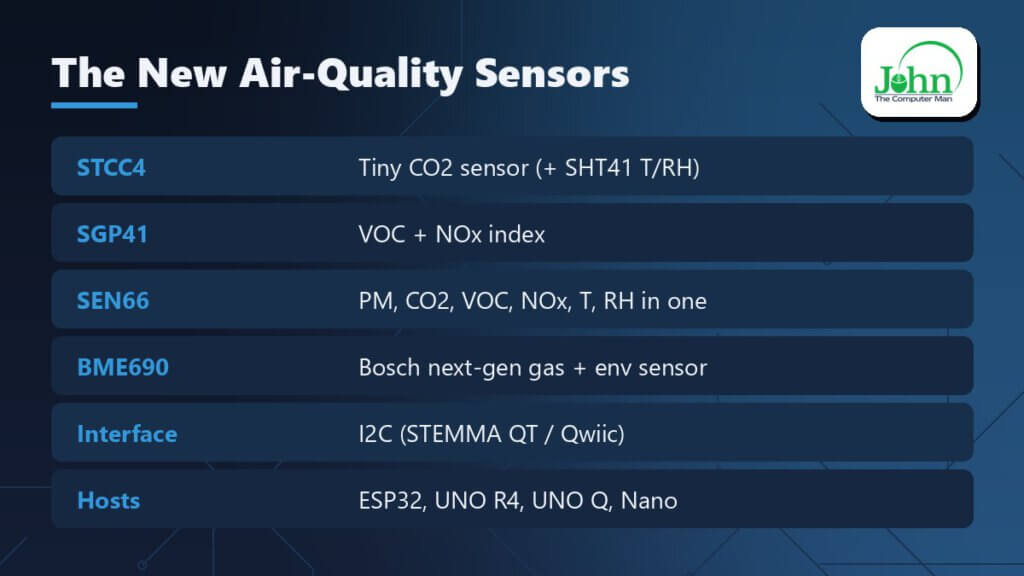
The new line-up
Sensirion STCC4: CO2 in a tiny package
The STCC4 is a miniature CO2 sensor that uses thermal-conductivity sensing. It’s much smaller and cheaper than the NDIR/photoacoustic sensors makers usually buy. Adafruit’s breakout (March 2026) pairs it with an SHT41 temperature/humidity sensor, which the STCC4 uses for compensation. It’s a great fit for battery-powered room monitors.
Sensirion SGP41: VOC and NOx
The SGP41 is a metal-oxide gas sensor with a dedicated NOx pixel. It reports VOC and NOx indices through Sensirion’s gas-index algorithm. These track changes in air quality, like cooking, cleaning or a gas hob, rather than exact concentrations. Adafruit released a STEMMA QT breakout in February 2026.
Sensirion SEN66: the all-in-one
If you want one module, the SEN66 measures PM1/2.5/4/10, CO2, VOC, NOx, temperature and humidity in a single fan-driven unit. It costs more, but it’s pre-calibrated and saves a lot of wiring.
Bosch BME690: the next-gen gas sensor
The successor to the popular BME688 combines gas, humidity, pressure and temperature. It works with Bosch’s AI tooling for training “smell” classifiers.
Building a monitor
- Pick an ESP32 (C6 or C5 if you want Matter/Thread, or an S3 if you want a display).
- Daisy-chain the sensors over Qwiic/STEMMA QT. No soldering needed.
- Let the sensors warm up. Gas sensors need minutes to hours to settle, and CO2 sensors need fresh-air calibration.
- Send the data to Home Assistant via ESPHome, or show it on an e-paper display.
- Add alerts. A buzzer or LED that turns red above ~1,000 ppm CO2 is an easy “open a window” reminder.
Placement tips
- Put it at breathing height, away from windows and heaters.
- Keep it out of direct sunlight, which skews both temperature and gas readings.
- Give PM sensors airflow and don’t box them in.
Bottom line
STCC4 + SGP41 on an ESP32 is the best-value DIY air monitor in 2026. SEN66 is the premium all-in-one choice.
